Biography
In the early 1980s I was living in Sri Lanka and was involved with a UNESCO project of excavation and conservation of the Ancient Cities. One of our visitors was Eve Ritscher, who was a promoter of early holography.
The first hologram I saw was one she had with her when she came to stay. I was particularly intrigued by the holistic concept of how the smallest part of a hologram contains the whole. When I was back in London I went to see the Light Dimensions Exhibition at the Science Museum which Eve had organised.
In the exhibition there were many remarkable holograms made by the early pioneers. One which caught my attention was an early Russian hologram. The Russians had been making holograms of artefacts in the Hermitage Museum in St. Petersburg.
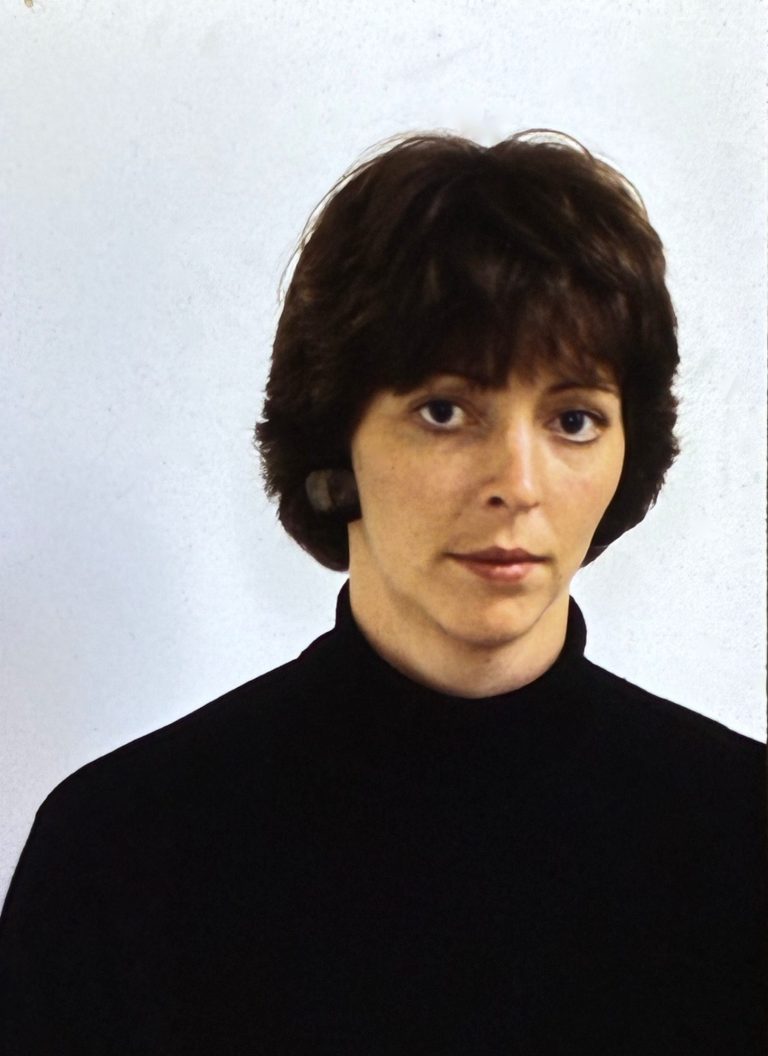
As I had worked with antiquities, I could imagine the many ways holography might be used in museums. I also thought that in the same way photography had made painting accessible to many, holography could do the same for sculpture. In retrospect, I realise this was a misplaced idea. Anyway, it was enough to spur me on to investigate further.
In 1984 I returned to England and did a short holography course at Richmond Holographic Studios. After this, I was introduced to Adrian Lines who had a holographic studio in London. When I worked for him we had an arrangement of exchange of work for studio time. This gave me the opportunity to begin making holograms myself. I was keen to pursue the idea of the use of holography in museums and started to make holograms of antiquities in order to build up a portfolio.
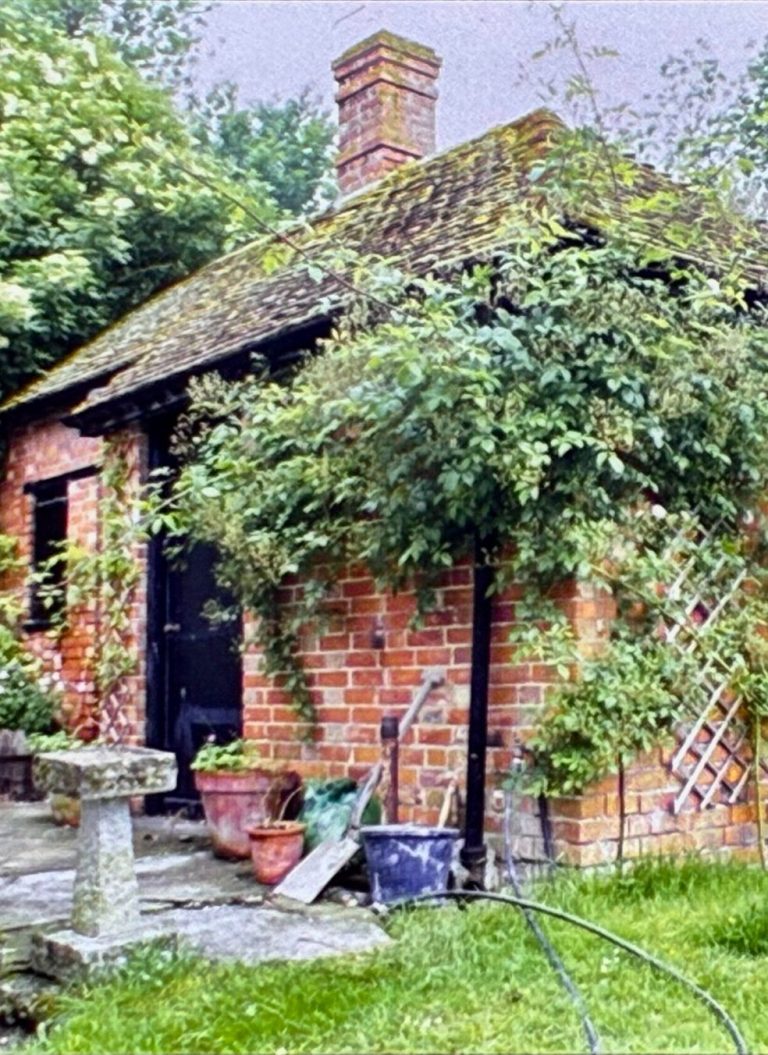
In 1985 I decided to build my own studio in the garden at home in Wiltshire.
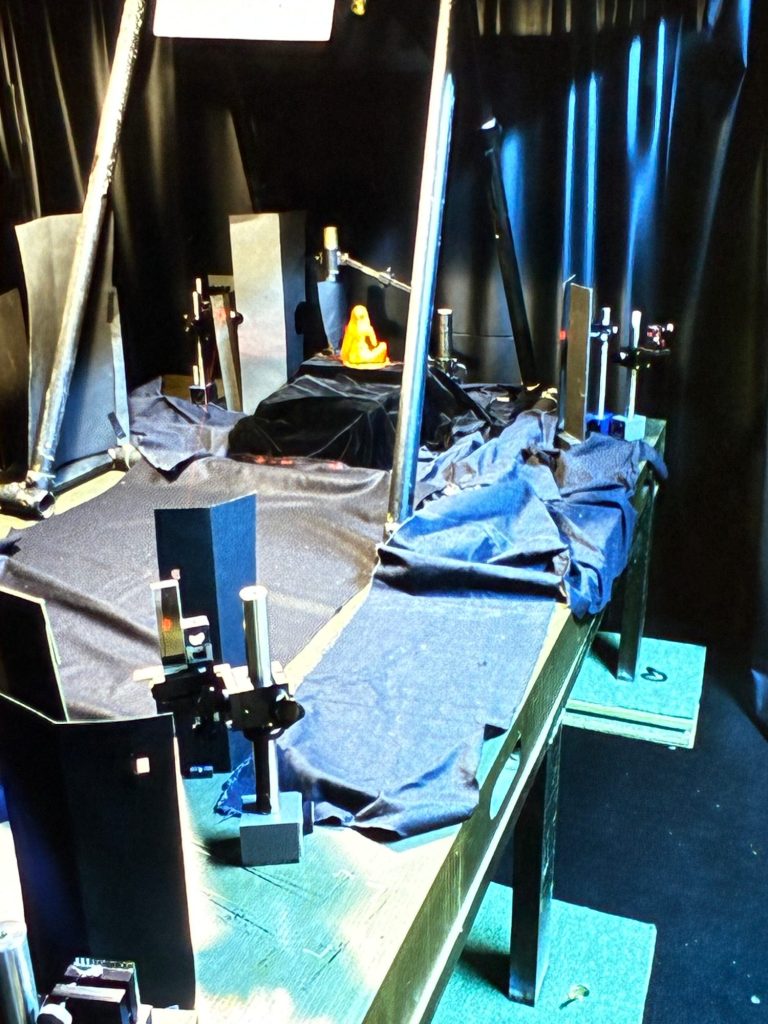
Stability is an extremely important factor in holography. The smallest amount of movement or vibration - for instance even a slight air current can cause problems. A holographic table, weighing well over a ton was moved into the shed by crane and ‘floated’ on car inner tubes to isolate the optics from any vibration.
I started to make and produce holograms for an Ancient Art Series. This enabled me to learn more about the craft of holography and build up a portfolio of work.
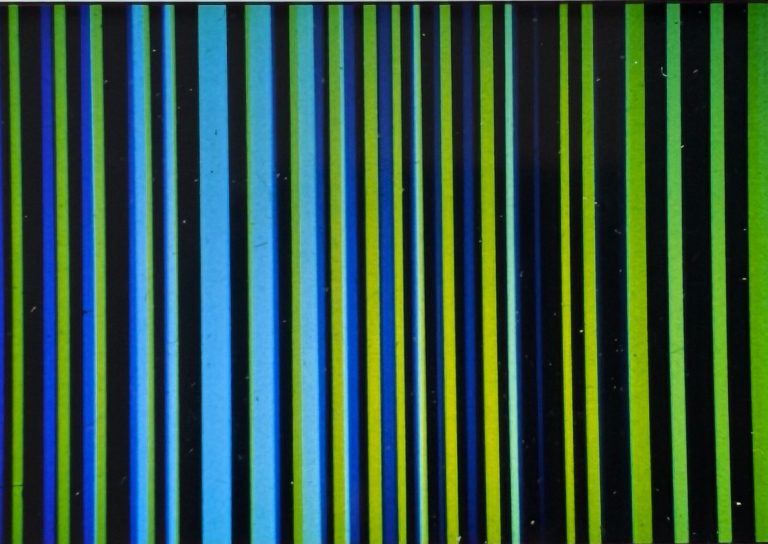
A few years later the Royal College of Art built a holographic facility and in 1987 I became a student there. During this time my interest changed and I moved away from figurative work and the holograms became more abstract. I was most interested in the medium itself - for instance the way in which parallax could create movement and kinetic effects. Another of holography’s unique attributes was the ability to pull light off the picture plane. I began to experiment with colour mixing - as unlike any other medium - it was possible to mix pure spectral colour in space. I became less interested in the three dimensional aspect of holography and started to imagine how holograms and their optical effects could be used in architectural glass.
---------------------------
Image:
Barcode, 8”x10” hologram on glass.
Although unknown to me at the time, Pilkington Glass PLC were also looking into the possibilities of holography in architectural glass. It was a fortunate coincidence, as they picked up on my work at the Royal College of Art degree show in 1989.
During subsequent discussions I proposed the possibility of using holography as a process to make optically active glass. I had a number of ideas on this front - one of which was to build on the work I had been doing on colour and to demonstrate the range of colour which was possible with holography.
I had to sign a non disclosure contract, which from a personal point of view was difficult as I could not share the work I was doing with my peers in the holographic community. After a few good and exciting years the project came to an untimely end. It was a commercial decision. The company’s experience with head-up-display technology made development in their automotive industry a better option than developing the holographic research in architectural glass.
While it was disappointing, the project got much further than I ever expected. I was surprised by the interest and enthusiasm of a number of internationally renown architects who were keen to implement some of the ideas into their buildings. It was a very stimulating time and I enjoyed the work - especially the exchange of ideas. At that point I was bound by my contract and could not work for anyone else for five years. As I had no inclination to go back to commercial holography - my time in holography came to end.
However, the experience of working with laser light led to an interest in the metaphysics of light and darkness, particularly in sacred art and theology. I was later able to explore this while doing research on Byzantine icons and mosaics.
------------------------------
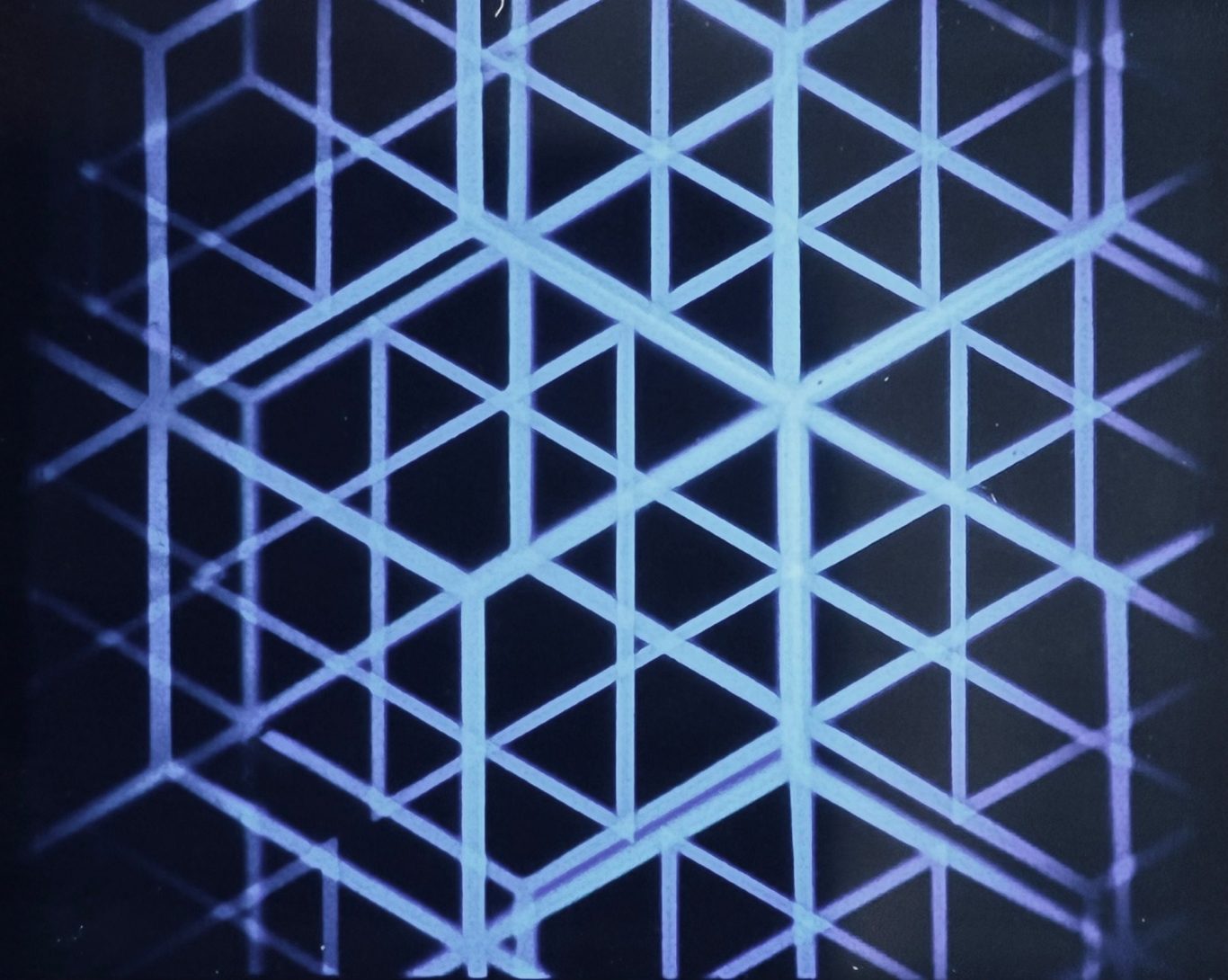
Image:
Hexagram, 30x40cm hologram on glass.
Exhibitions
1985 Laser Magic, Brighton, UK
1987 Illuminations, State of the Art Holography, Royal Photographic Society, Bath, UK
Le Troisième Regard, L’Espace Bleu, Paris (Solo)
1988 Palace of Light, Diorama, London
1989 Holography, National Museum of Science & Technology,
Haifa, Israel Installation with Pepe Buitrago,
Benjamin Rhodes Gallery, London
1990 Royal College of Art Exhibition, Braunschweig, Germany
1991 4 Young British Holographers, Interference Gallery, Toronto, Canada
4 Young British Holographers, Museum of Holography, New York
1992 Videoarco ’92, Installation with Pepe Buitrago, Madrid, Spain
1993 3x8+1, Milton Gallery, London
1995 Holograms from around the World, Aberdeen Art Gallery, Scotland
The Art of Holography, National Museum of Photography & Television, Bradford
1996 Raum in Sicht, Magie in 3-D, Technorama, Winterthur, Switzerland
1997 Holograms from the Jonathan Ross Collection, Members Gallery, RPS, Bath
2000 Selected Works from Jonathan Ross Collection, Butler Institute of American Art
2006 Holography the 3-Dimensional Experience, Bodelwyddan Castle, Wales
2008 Holograms, the first 60 years, Rugby Art Gallery, The Oxfordshire Museum, UK
2009 Holograms, the first 60 years, The Alton Museum, The York College Gallery &
The Buckingham County Museum, UK
Group Shows at Gallery 286, London:
1998, 1999, 2003, 2005, 2023, 2024, 2026
Work by Caroline Palmer is held in the Jonathan Ross Hologram Collection.
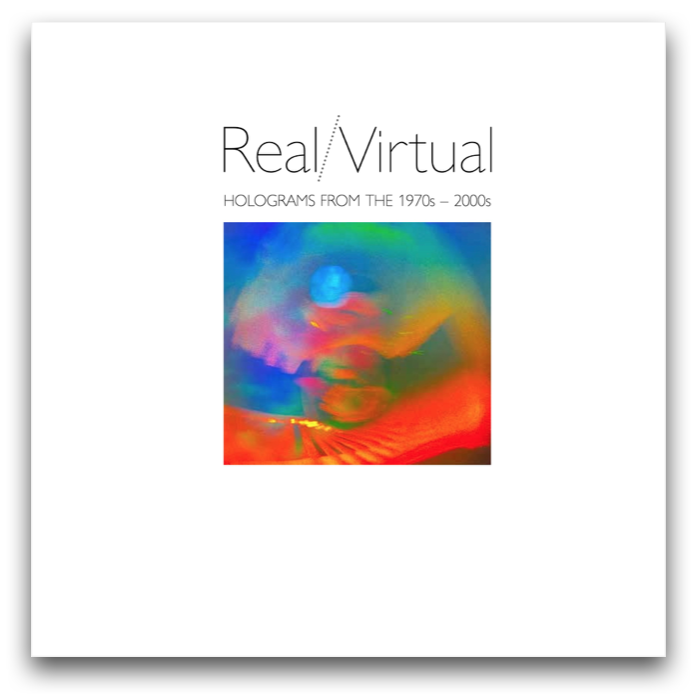
Real/Virtual
Holograms from the 1970s-2000s
Gallery 286, London.
Exhibition catalogue available to download as a pdf.