ANCIENT ART SERIES
Between 1984-1987 I made a number of holograms of antiquities. This portfolio formed the basis of an Ancient Art Series which I produced and sold internationally.
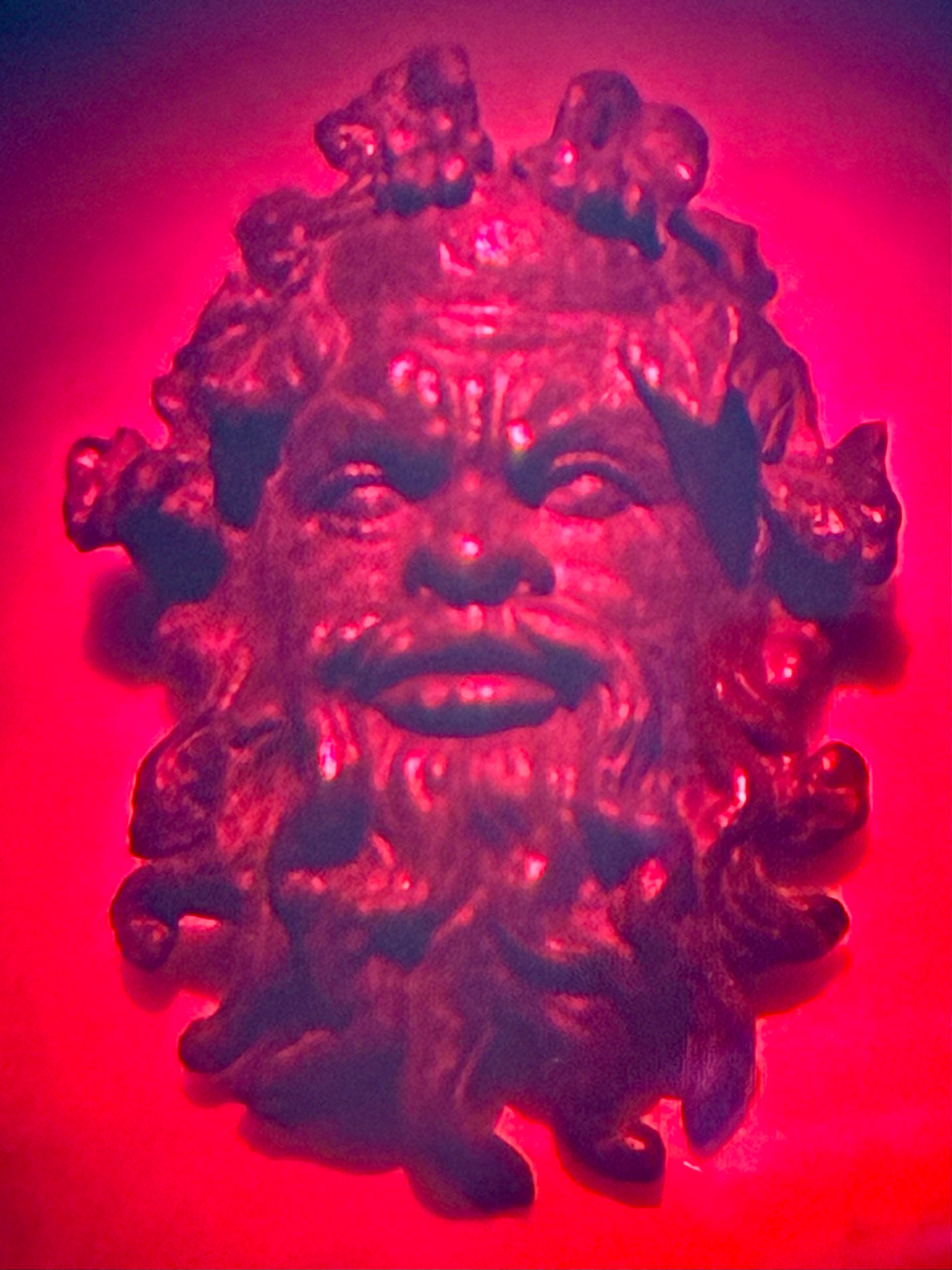
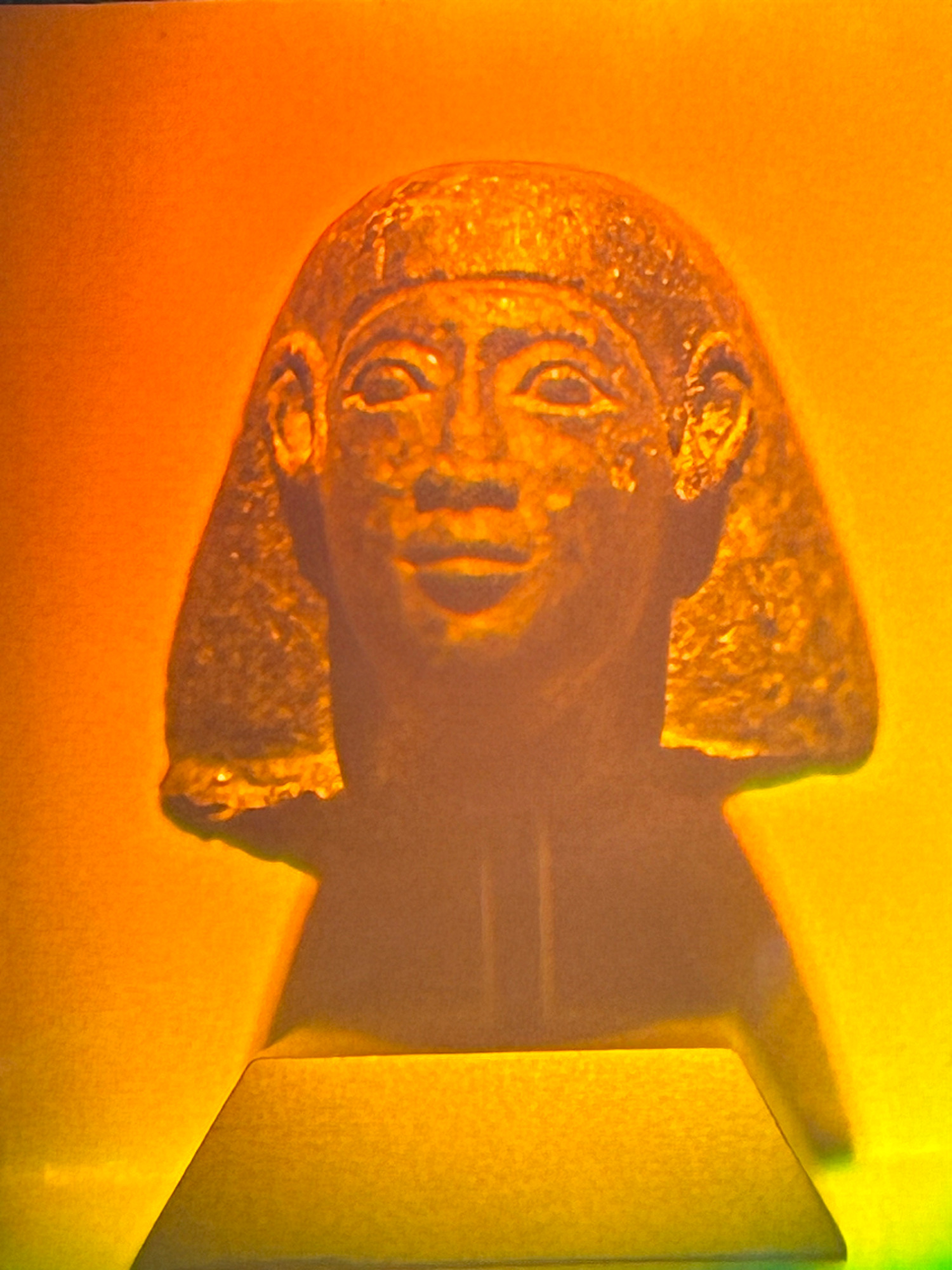
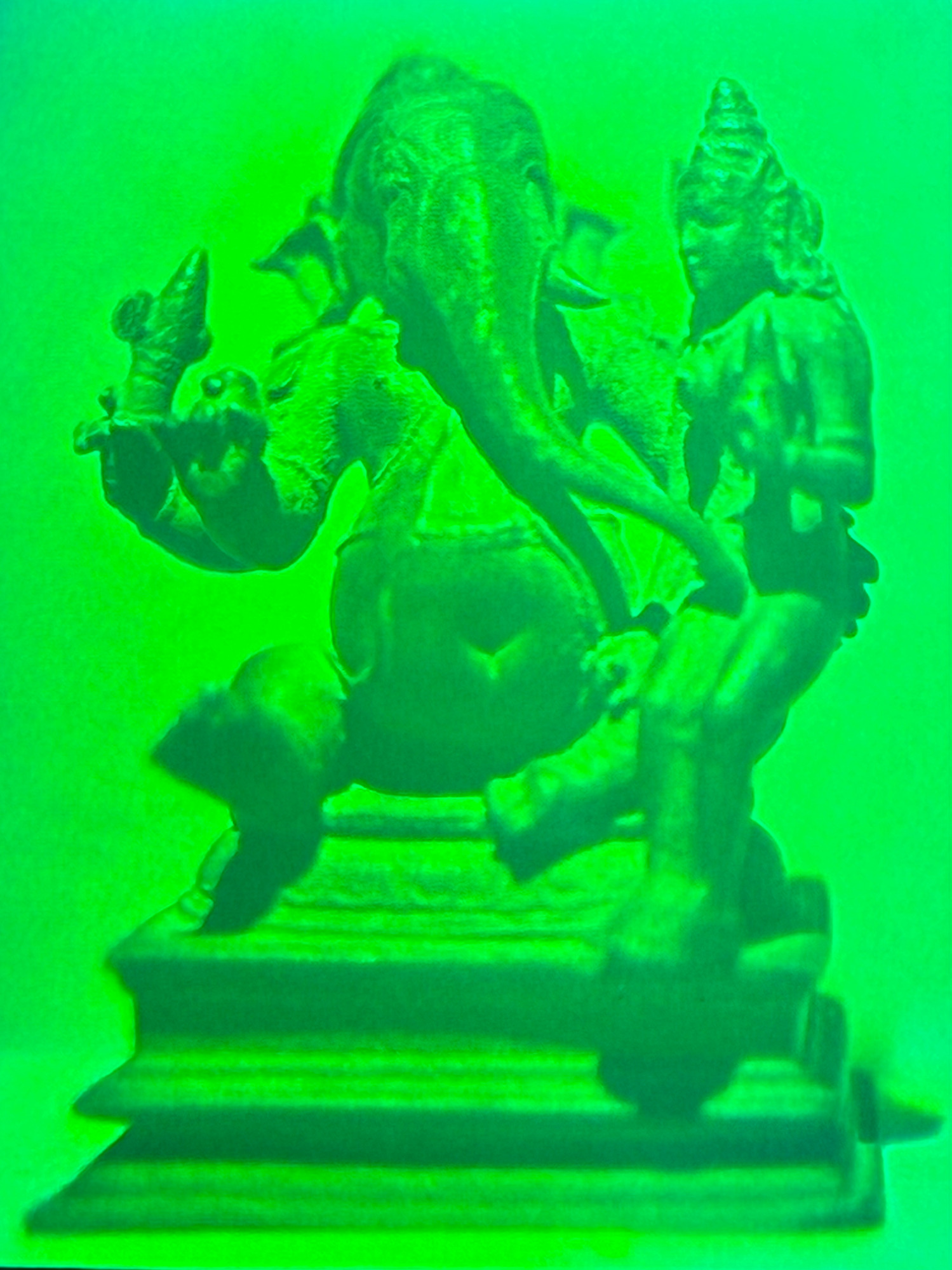
The following holograms are from this Series. Each image will tend to vary in colour, for instance Silenus, The Egyptian Head & Ganesha can be in red, orange/yellow and green.
Scroll down for details of each work
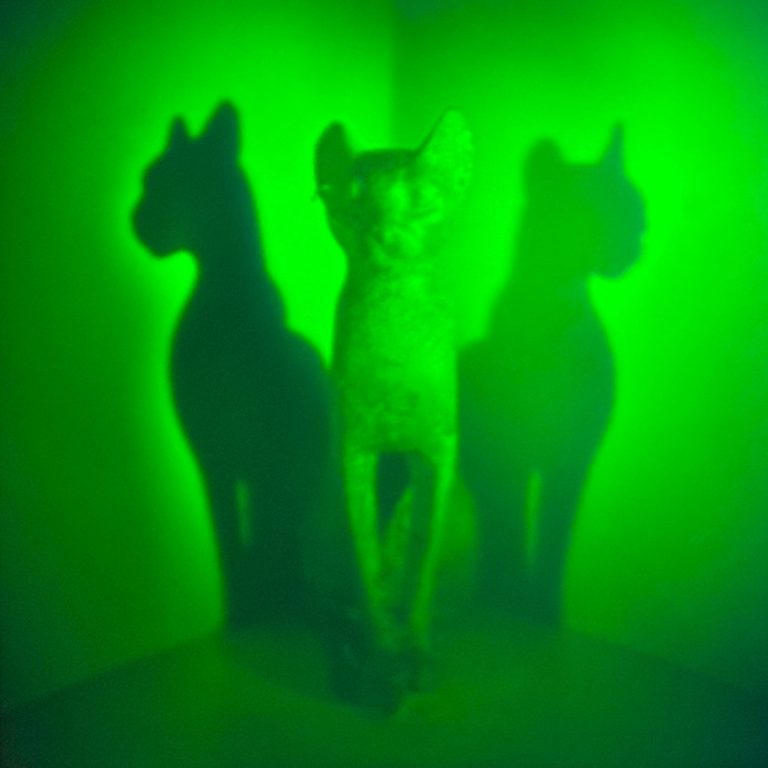
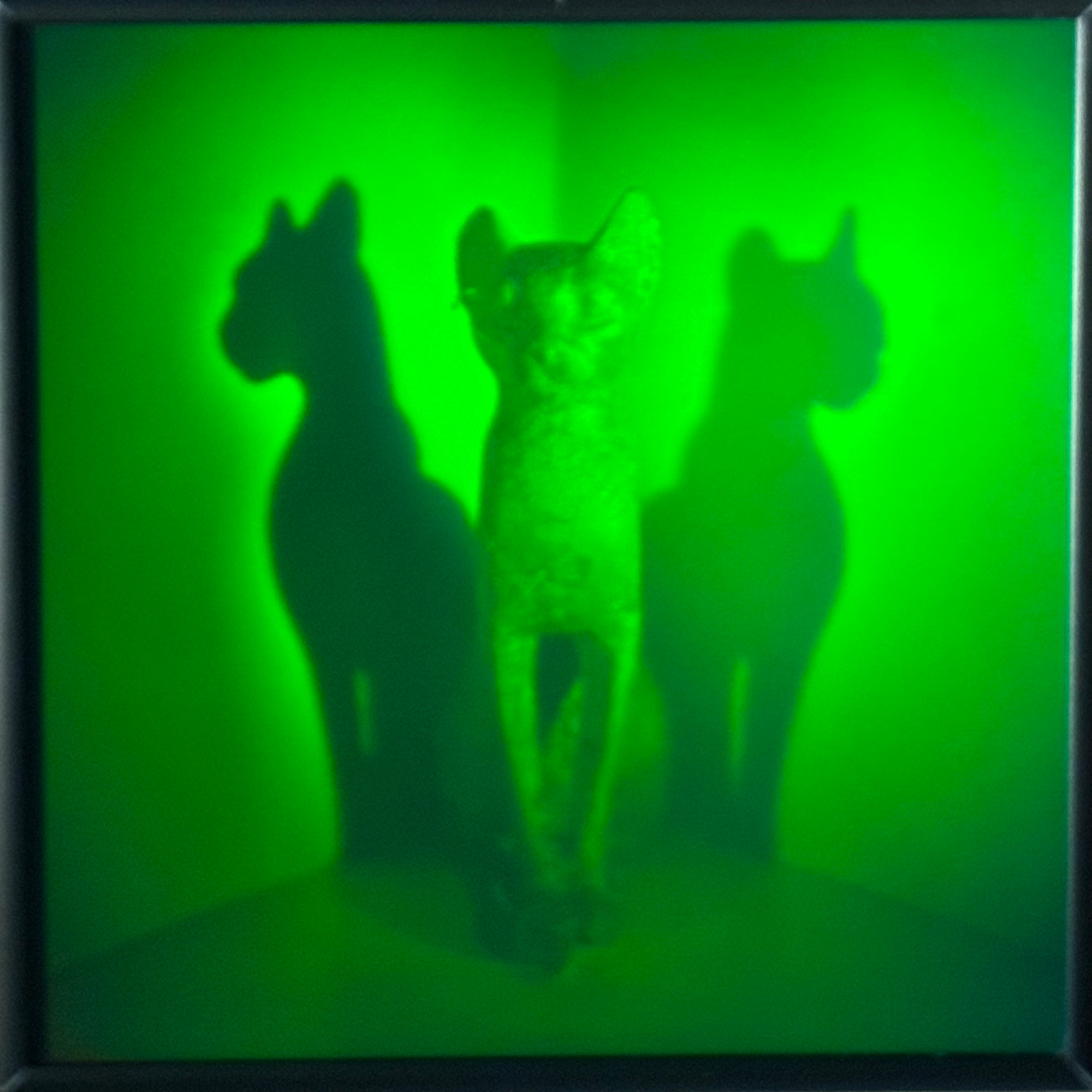
Egyptian Cat
8”x 8” reflection hologram on glass in a metallic frame. Side lit. Bronze cat with a gold earring, 1st century BC, Egypt.
£500.00
The ancient Egyptians were almost certainly the first people to domesticate the cat. Their wall paintings show that they used cats for hunting, as they were trained to flush out birds. Perhaps because of their aloofness and grace, the Egyptians revered cats from the earliest times. In the Book of the Dead, the sun god Ra takes the form of a cat to slay the serpent of night. A victory which symbolises the triumph of light over the forces of darkness.
This association with the sun continued later on when the cat became the sacred animal of Bastet, who was regarded as either the wife or daughter of Ra. With a cat’s head and woman’s body, Bastet was a kindly figure who represented the beneficial powers of the sun. She was the goddess of maternity and fecundity, happiness and pleasure. Amongst the rituals of her cult were processions of gaily decorated barges along the Nile and orgiastic rites.
This bronze cat would probably have been sold on a temple stall among many other cats, ranging from tiny blue faience amulets to large images in solid silver hung with elaborate jewels. The worshippers either dedicated them to the temple, or else took them home to protect their houses and crops. The Egyptians were extremely fond of their pets and when their favourite cats died, they sometimes had them embalmed and mummified. These would have been taken to the famous cat cemetery in Bubastis where they were buried with great ceremony.
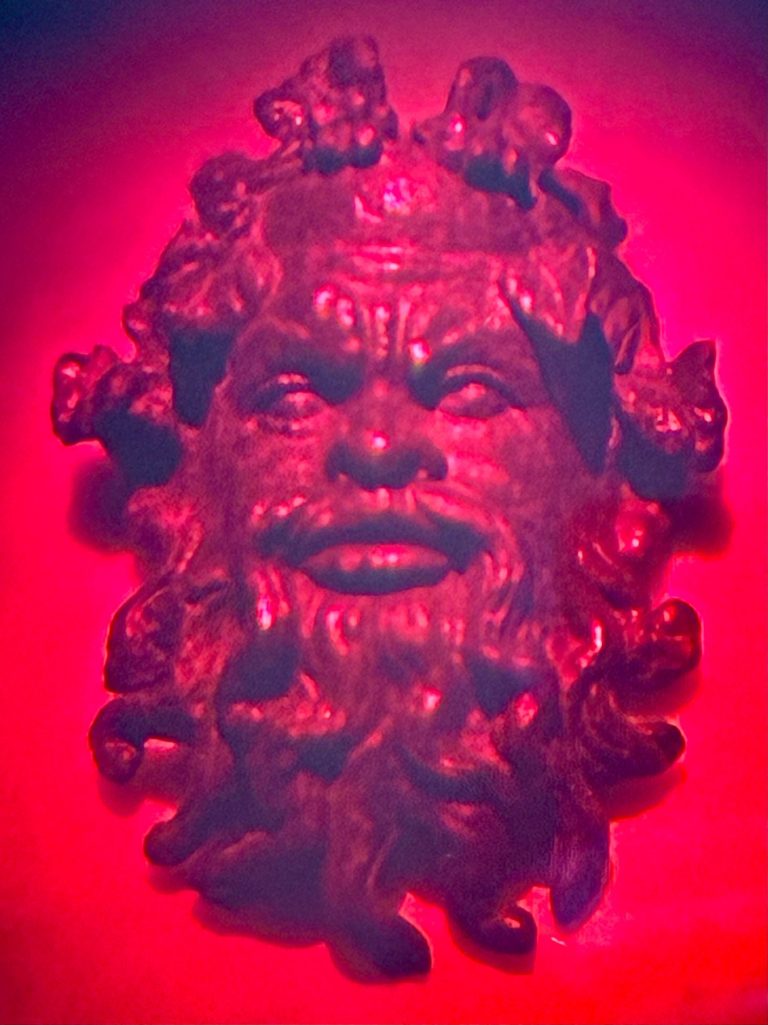
Silenus
4”x 5” reflection hologram on glass
Bronze roundel of a satyr, 2nd-3rd century AD, probably from Alexandria, Egypt.
£100.00
Silenus was a woodland spirit from Phrygia in western Turkey. He had pointy ears and a snub nose and apart from the wreath of vine leaves in his hair, he went naked. He was profoundly wise and constantly drunk. He had great gifts of prophecy and many followers in the Greek speaking cities of the eastern Mediterranean. Silenus became the tutor of all the Satyrs and his most famous pupil was probably Dionysus, better know by his Roman name of Bacchus, the god of wine. When Dionysus went mad and started wandering through Asia, Silenus decided to accompany him and with ‘a rout of Satyrs and wild women’ they caroused their way eastwards.
After visiting India, Silenus decided to return to Turkey where his prophetic powers were in great demand. He would only reveal his predictions under extreme pressure and one day his was kidnapped and taken in chains to King Midas of Lydia. The king took pity on him and instead of having him tortured, he set him free. In gratitude, Silenus granted the king a wish and endowed him with ‘the Midas touch’, so that everything he put his hands on turned to gold. The blessing swiftly turned into a curse and a few hours later when King Midas was unable to eat or drink, he begged Silenus to lift the spell.
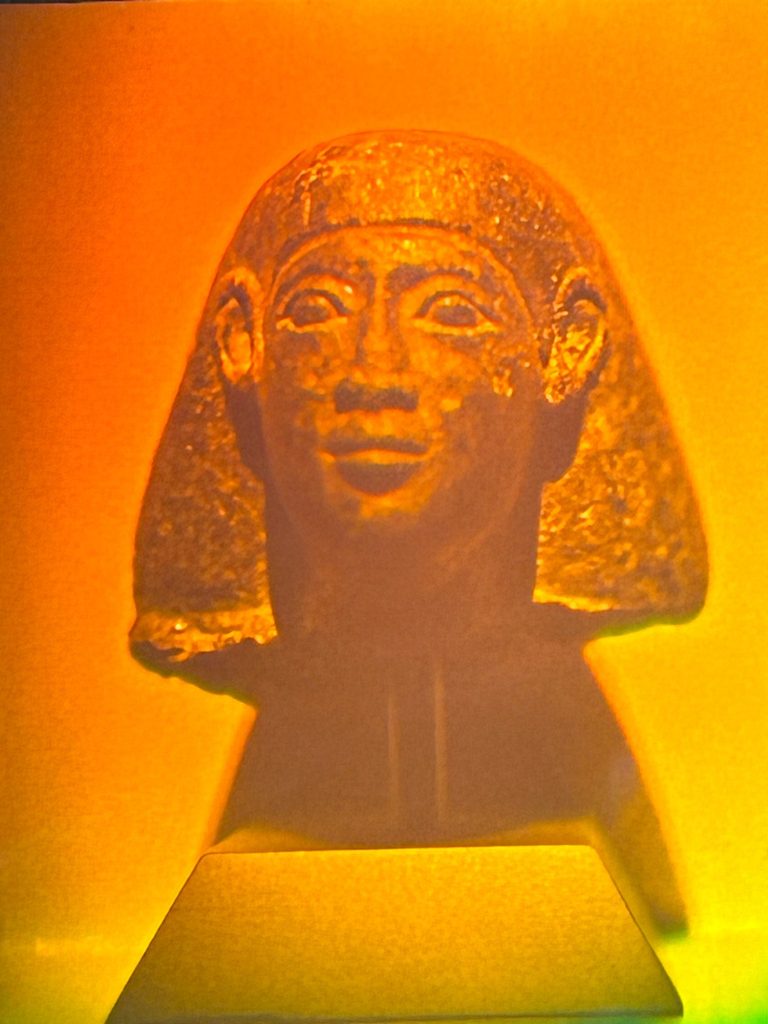
Egyptian Head
4”x 5” reflection hologram on glass
Funerary portrait of a government official, c.650 BC.
£100.00
This granite head comes from a small portrait figure and is remarkably realistic. Unfortunately, the subject’s name is not known, but the conventional linen wig which he wears neatly tucked behind his ears suggests he may have been a civil servant. The statue was probably intended to be placed in his tomb, to accompany him on his journey into the afterlife.
The stone is a type of black granite which would have been brought down the Nile from Aswan. By the time this head was carved, the formal style of Egyptian sculpture had already been in existence for nearly 2,500 years. During the 7th century BC there were close links between Egypt and Greece and the naturalism of contemporary Egyptian sculpture was a major influence on the development of Greek art. The body of this statue was almost certainly a striding figure, with one foot slightly forward to the other. This posture was one the Greeks came to imitate with their kouros figures.
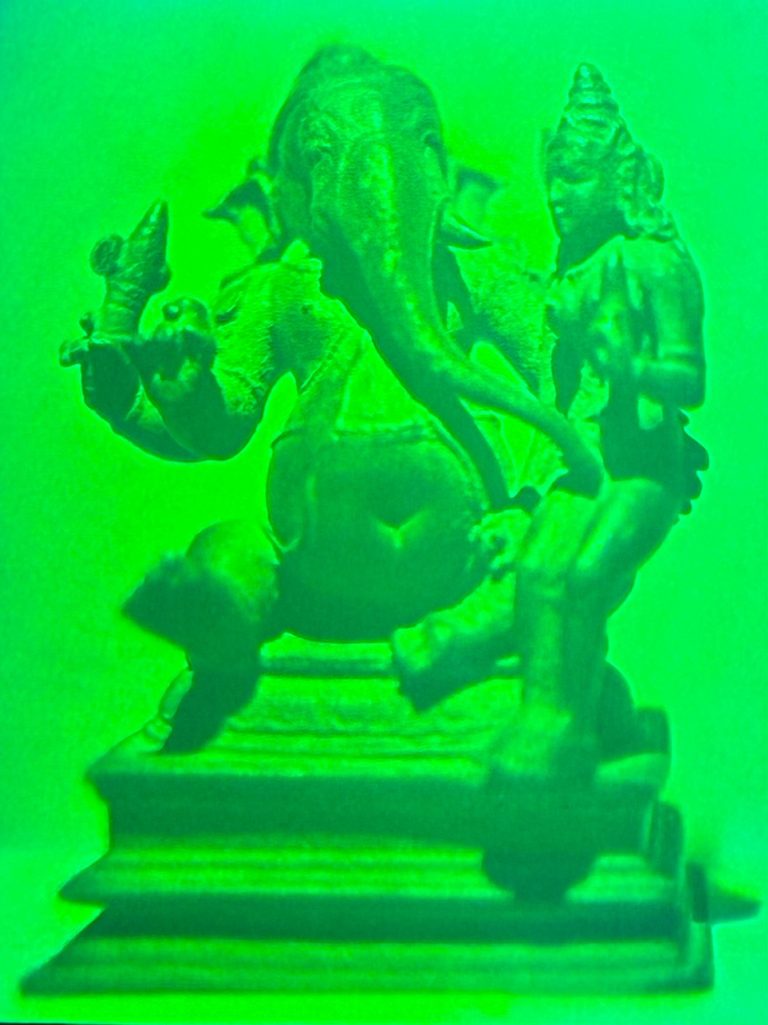
Ganesha
4”x 5" reflection hologram on glass
Bronze Hindu god embracing one of his wives, 13th-14th century, South India.
£100.00
Ganesha is the god of wisdom and learning and is said to have written down the Mahabharata, one of the great Sanskrit epics. He is also the remover of obstacles and is worshipped at the beginning of any new project, such as a journey, building a house, setting up a business or writing a book. The sculpture shows Ganesha with one of his two wives. Erotic motifs are often found in mediaeval Indian art. They are not considered to be salacious but are simply seen as a natural extension of human life, which is transposed into the sacred imagery of Hindu mythology.
Ganesha has a chubby figure and his pot-belly is due to his fondness for offerings of food - especially sweet cakes and fruit. The reason for his elephant shaped head is that when he was born, his mother Parvati invited all the gods to come and pay their respects. Sani, the planet Saturn, tried to refuse because he did not want to inflict his unfortunate influence on the new born child. Unfortunately Parvati insisted and when Sani looked at Ganesha, the baby’s head promptly turned to ashes. One of the other gods pointed out that if another head could be found immediately, the baby’s life could be saved. Vishnu flew off through the air and the first creature he saw was an elephant. He quickly lopped off the elephant’s head and placed it on Ganesha’s body.
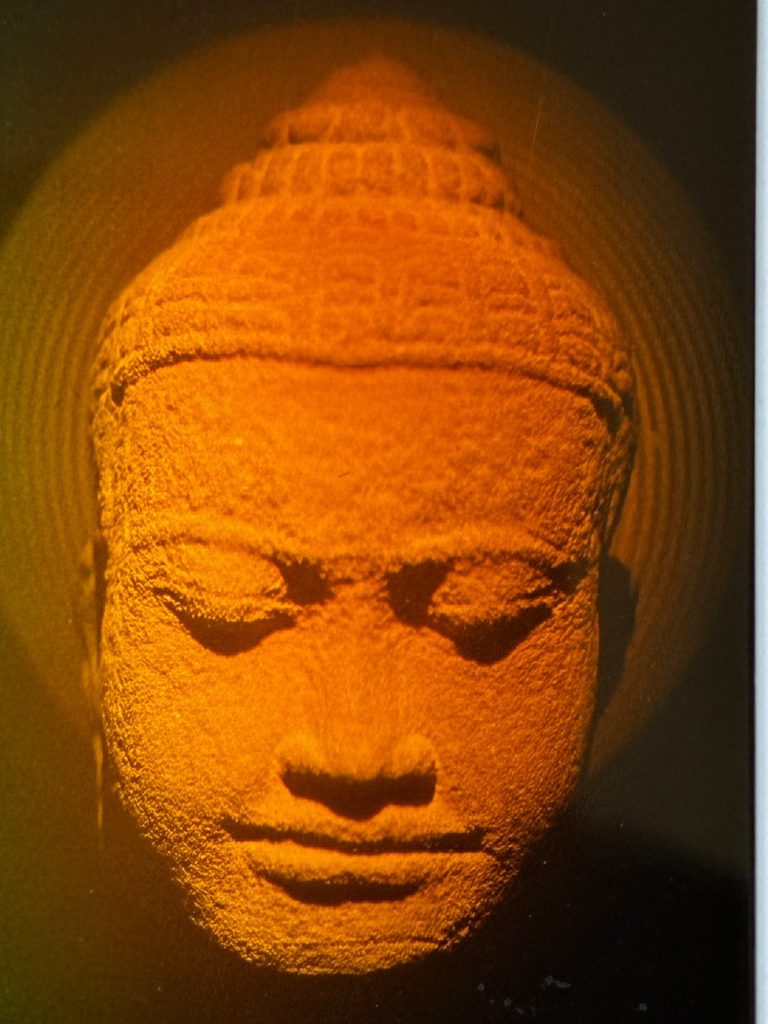
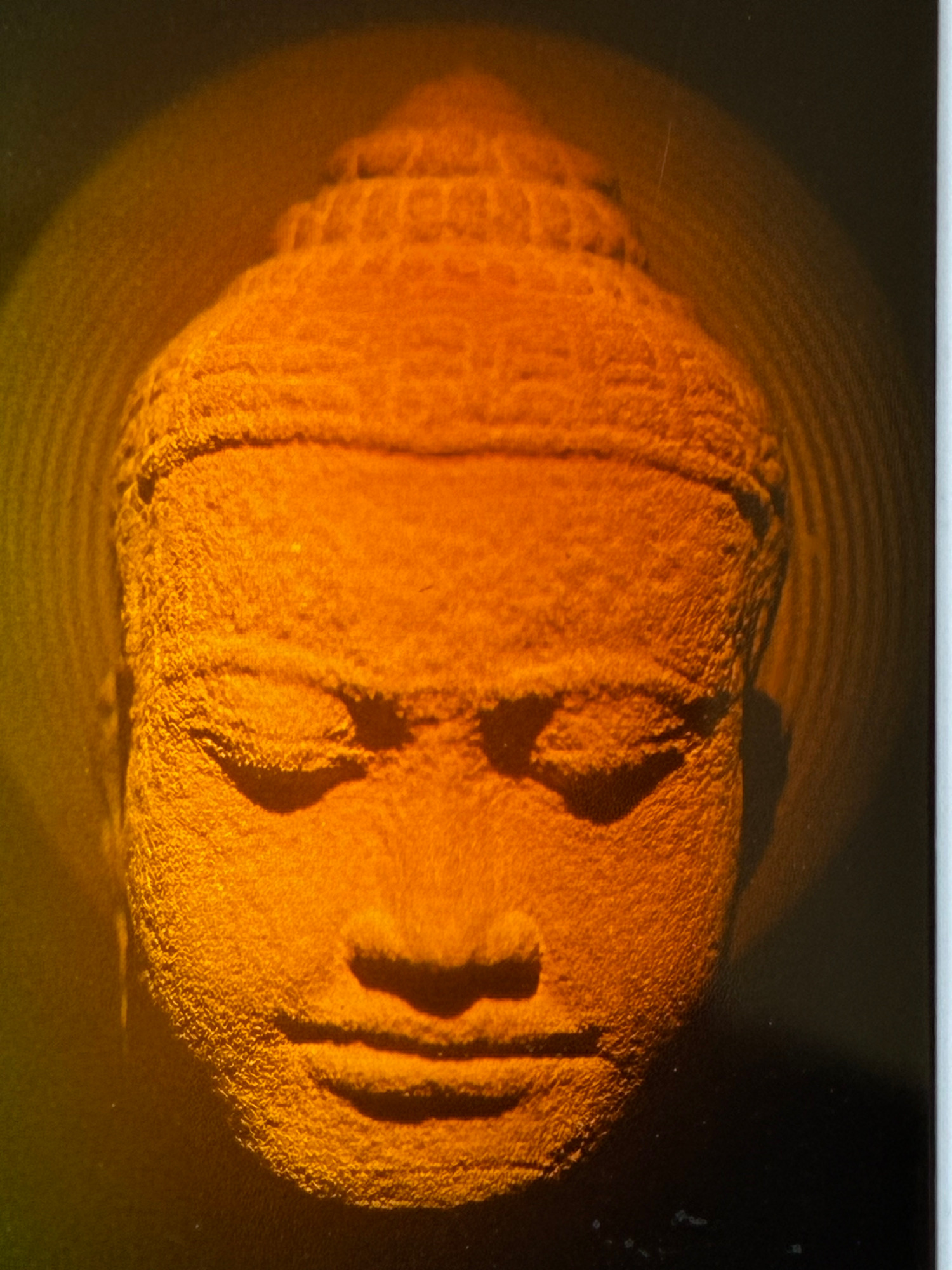
Khmer Buddha
8”x10” reflection hologram on glass
Sandstone head, 13th-14th century from Cambodia.
£600.00
This head comes from a statue of the Buddha which was made in Cambodia out of red sandstone. Originally the sculpture would have been painted and gilded, but its surface has now become slightly pitted and encrusted with age. It must have been made in the last era of the Khmer civilisation, the mediaeval Cambodian kingdom which was responsible for building vast monuments like Angkor Wat.
It was probably carved by a Buddhist monk and like all Buddha images it was intended to be an object of worship. It shows the Buddha after he had reached enlightenment. Nirvana, is a state of grace which is reflected in the calm serenity of the face.
Details like the tight curls, the top knot and drooping earlobes are dictated by the strict conventions of Buddhist iconography. Another standard feature is the halo behind the head made up of concentric circles. These were present in order to concentrate the mind during meditation. In this hologram the halo is created by interfering two circular wavefronts of laser light. This actually creates a lens - an interesting parallel to the iconography of concentric circles used to focus the mind in the Buddhist tradition.
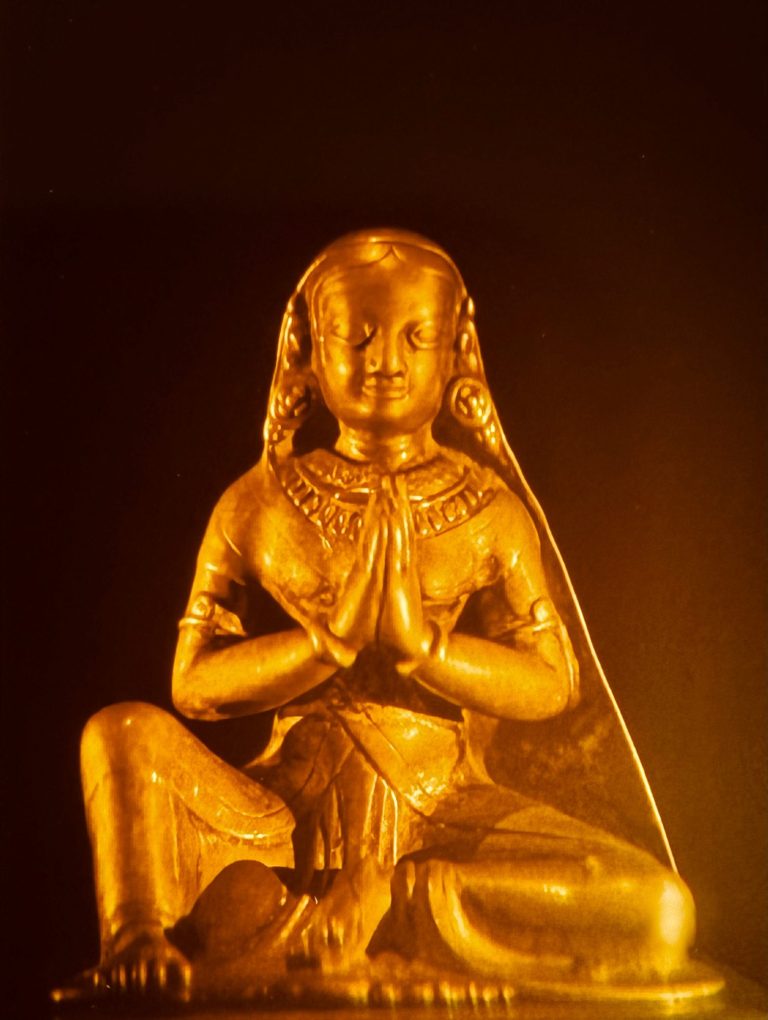
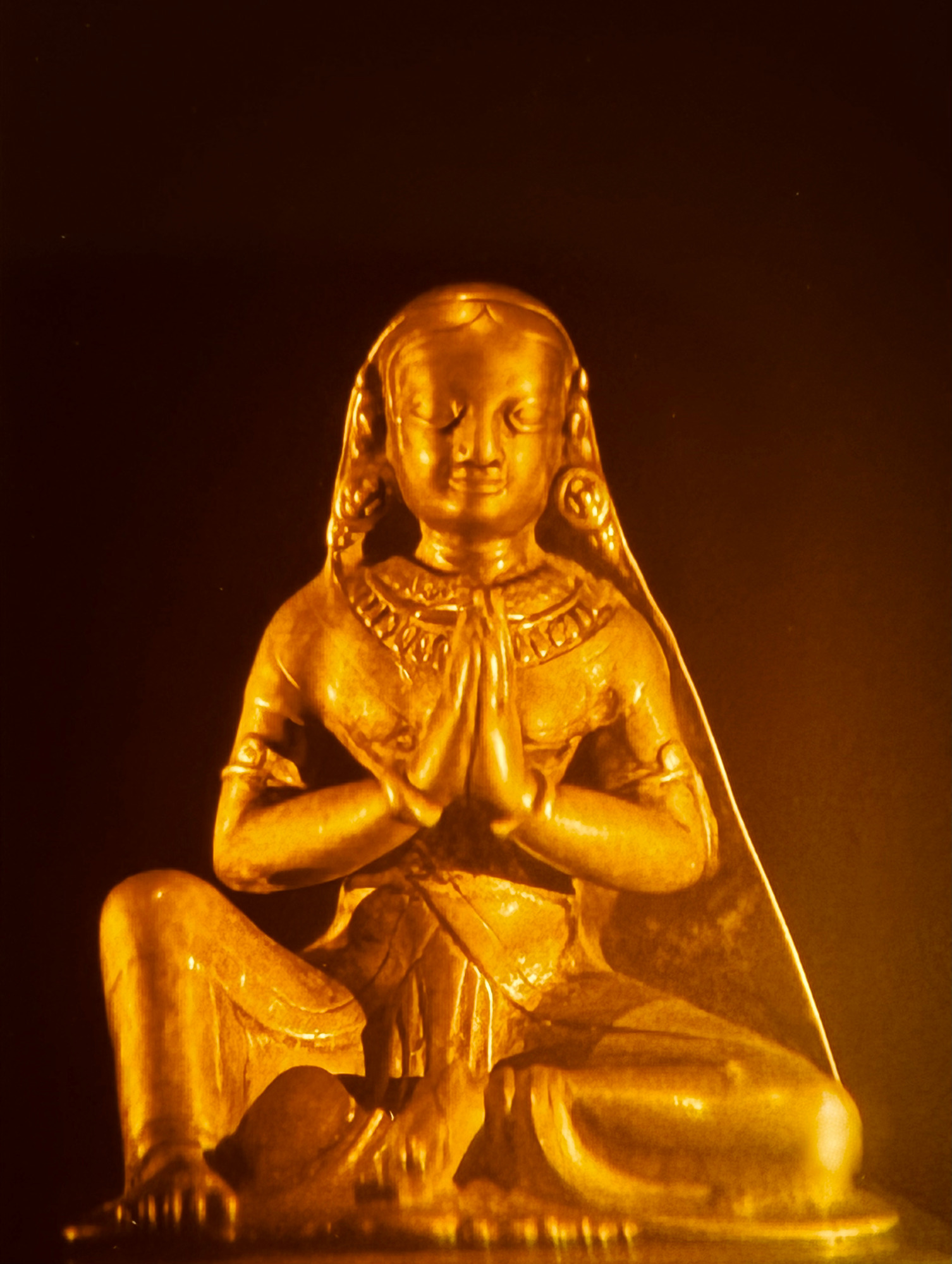
Nepalese Reflection
8”x10” reflection hologram on glass
Gilt bronze votive figure, 15th or 16th century from Nepal.
£600.00
Front view.
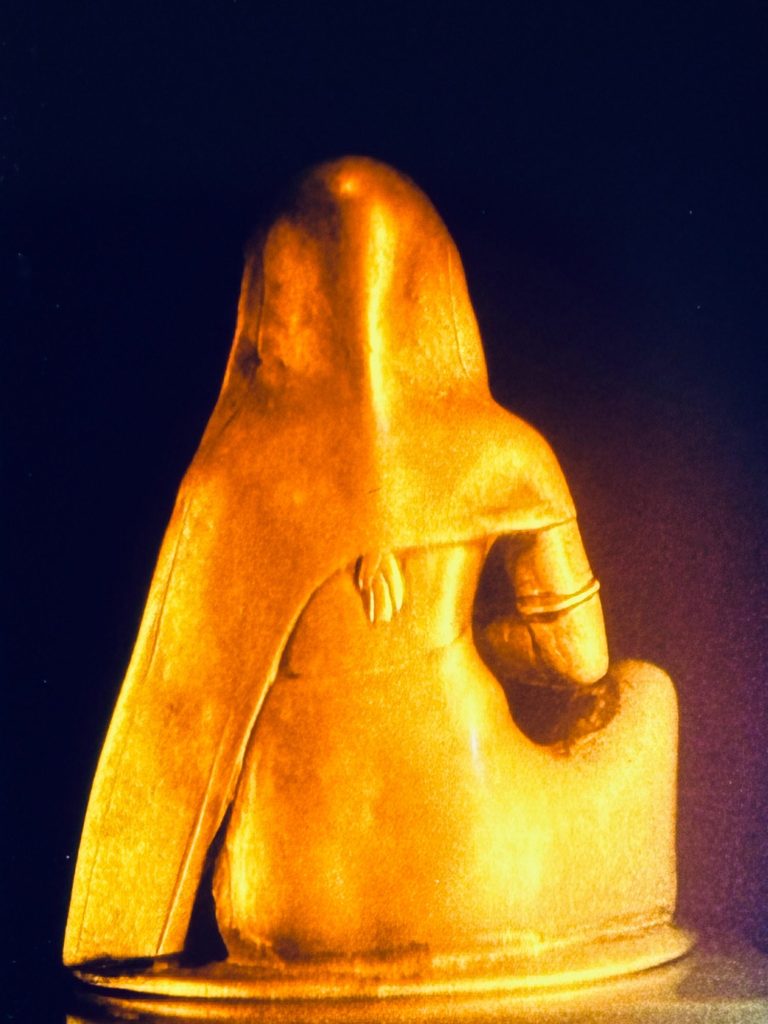
Nepalese Reflection
8”x10” reflection hologram on glass
Gilt bronze votive figure, 15th or 16th century from Nepal.
2 back to back holograms £1500
Back view.
This Nepalese figure show a pious Buddhist lay woman seated in an attitude of worship. These sculptures are known as donor figures because they represent people who donated groups of sacred images to their local temples in order to gain religious merit. The donor figures were then placed alongside the other images in the shrine. Whereas most Nepalese sculptures depict gods and demons, realistic works are fairly rare and this is one of the earliest examples of portraiture in Nepalese art.
The impressive display of jewellery suggests the donor was a relatively wealthy woman. Her necklaces and earrings would have been made of silver, while the oval pendant on her chest probably contained a charm of Sanskrit scriptures to protect her from harm. She is shown wearing her best temple going clothes - a pleated cotton skirt, coat and shawl - with her hair plaited in a pigtail at the back.
Cast from a brassy copper alloy, the figure was originally fire gilded and some traces of the gilding still survive. Parts of the image were subsequently plastered and painted and patches of gesso can still be seen around the necklaces and earrings.
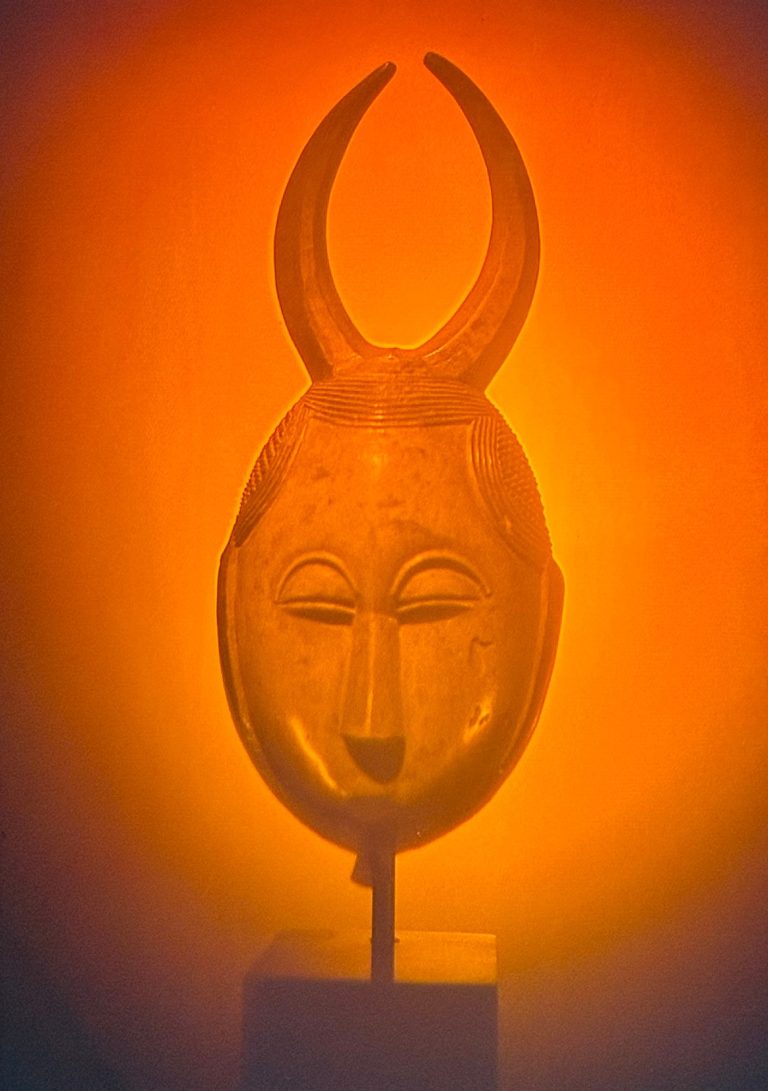
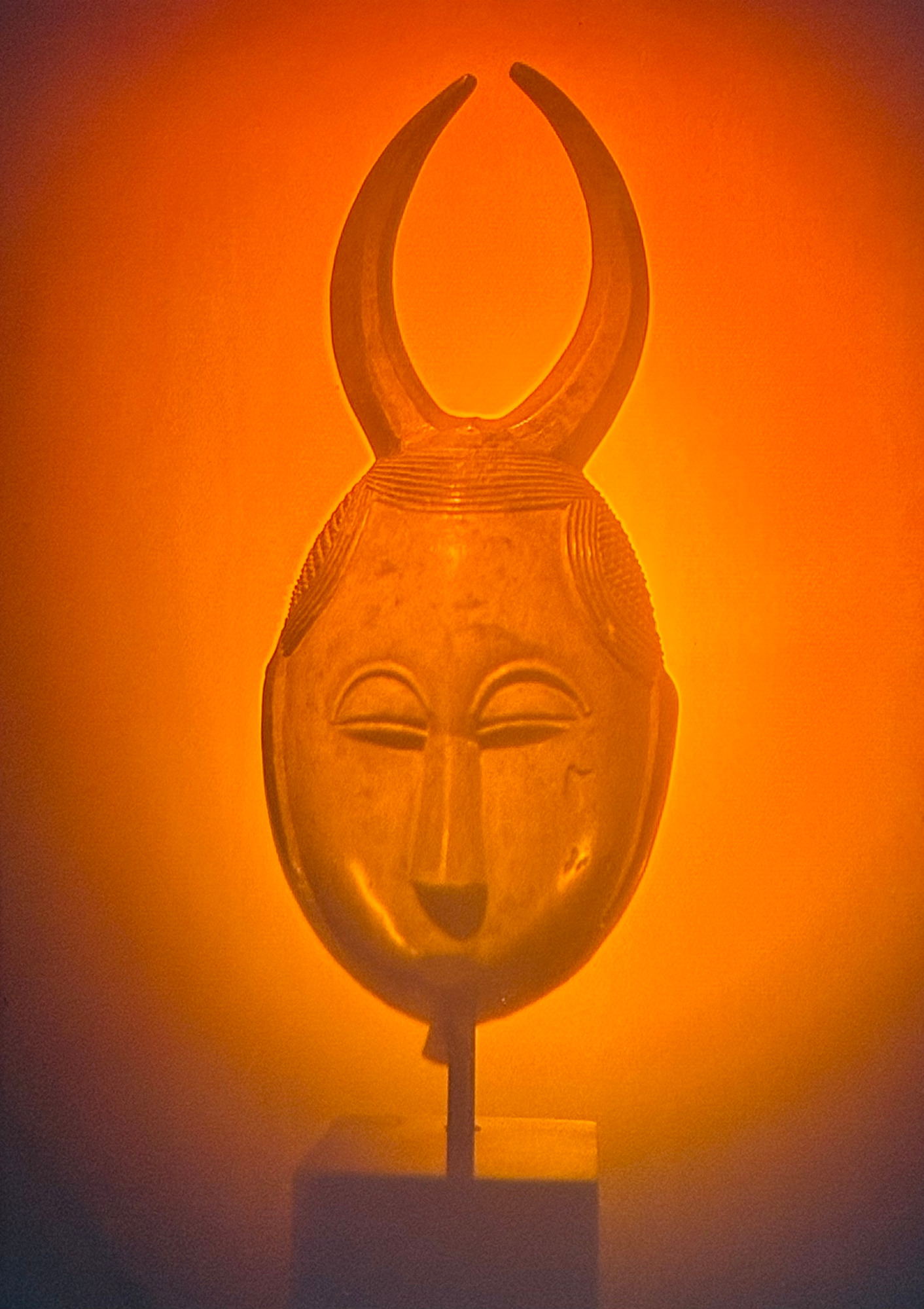
African Mask
30x40cm reflection hologram on glass
Wooden Yaure mask, 19th century from Ivory Coast.
£500.00
This mask was made by a Yaure wood carver during the second half of the 19th century. The Yaure are a sub tribe of the Baule who live in the savannah belt in the centre of the Ivory Coast.
Together with the Baule and neighbouring Guro tribe, the Yaure are considered to have produced some of the finest examples of African wooden sculpture.
The mask was carved from tropical hardwood and stained with red and black dyes. It was then polished to give a lustrous glow. It represents a cult official wearing a pair of buffalo horns. In Yaure mythology the buffalo is believed to be the progenitor of all forms of life and is the sacred animal of the great sky god Nyamye.
The mask was used during secret ceremonies conducted by the men of the tribe. It was worn on top of the head of a man in a grass costume, who rushed through the streets
lashing out in all directions. He would be accompanied by a man blowing a buffalo horn who warned of his approach. Women and children were forbidden to look at the mask and they were forced to stay in their huts until the figure had passed.
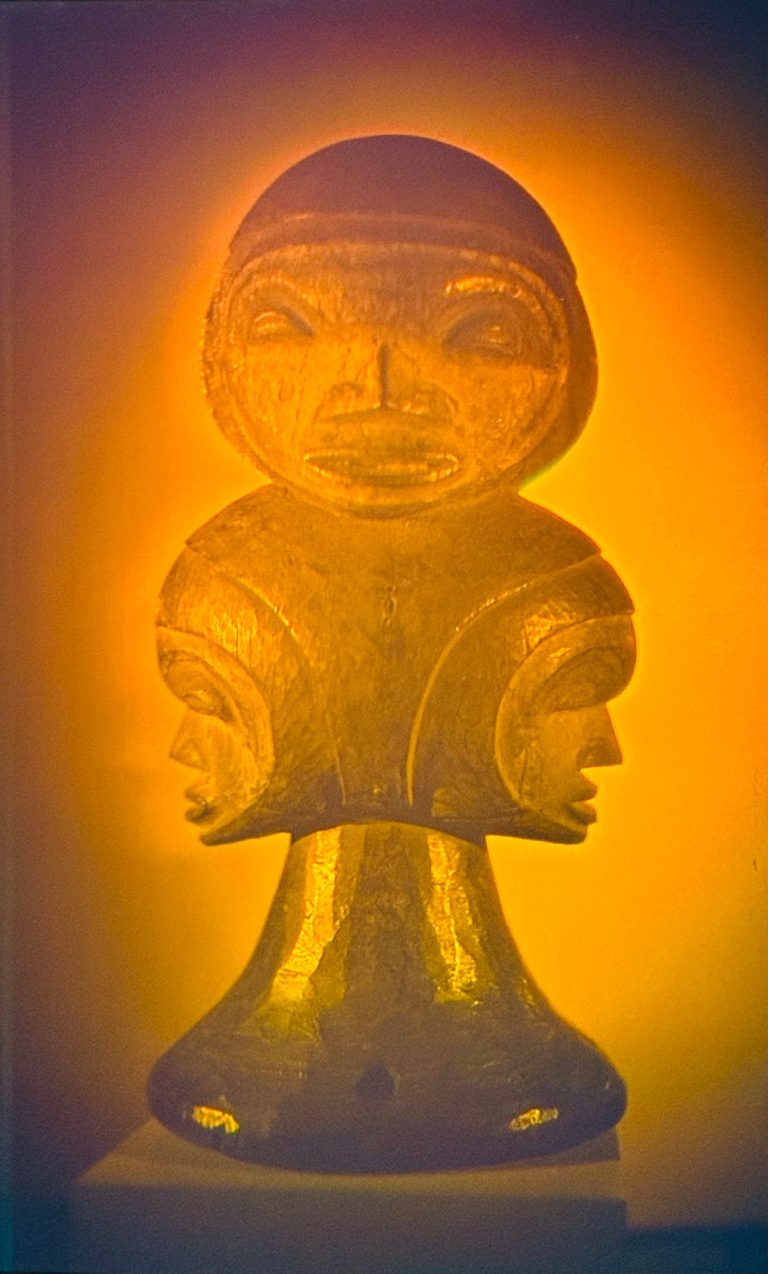
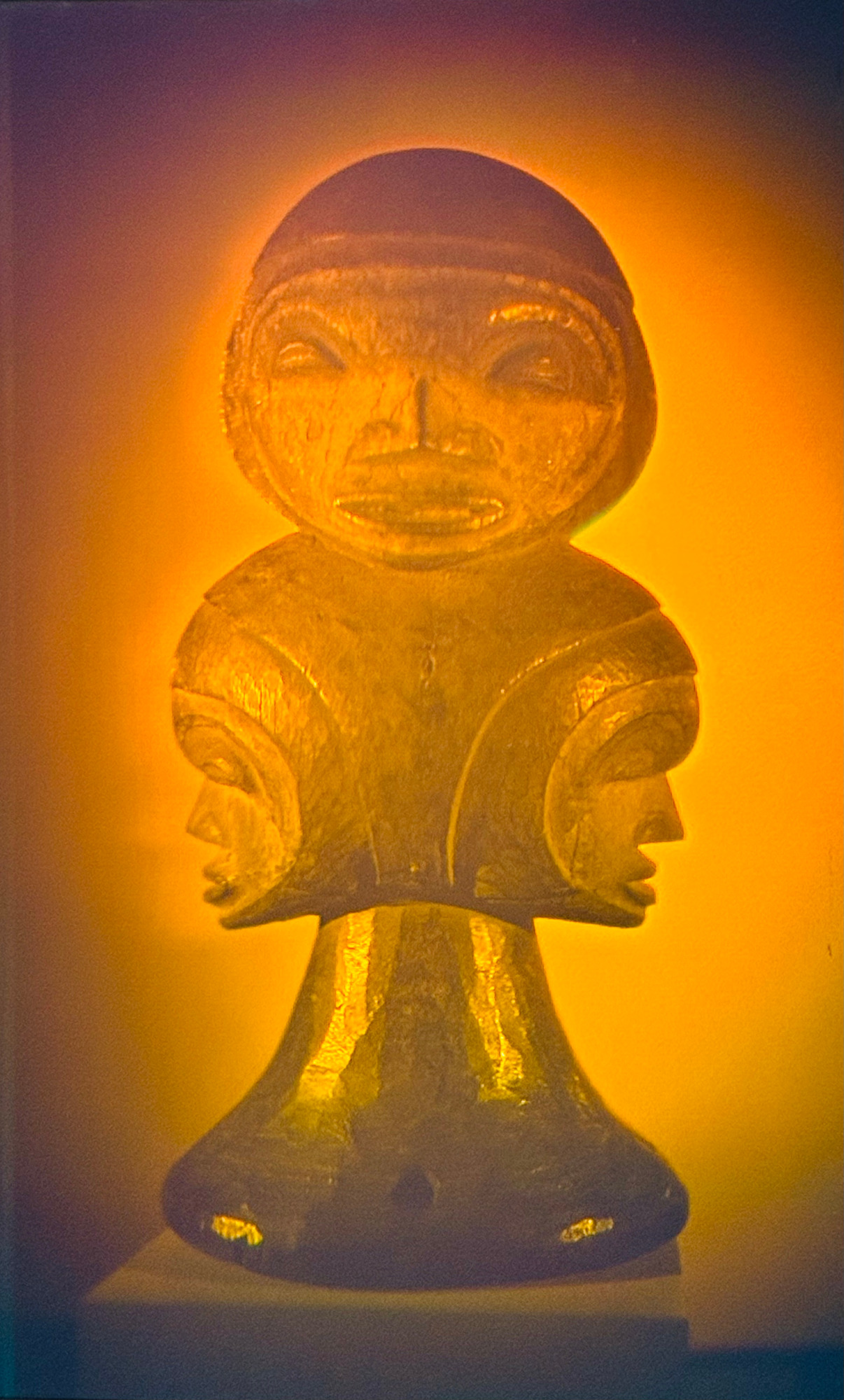
Idoma Figure
23x38cm reflection hologram on glass
Four faced wooden mask,19th century, Eastern Nigeria.
£500.00
Front view.
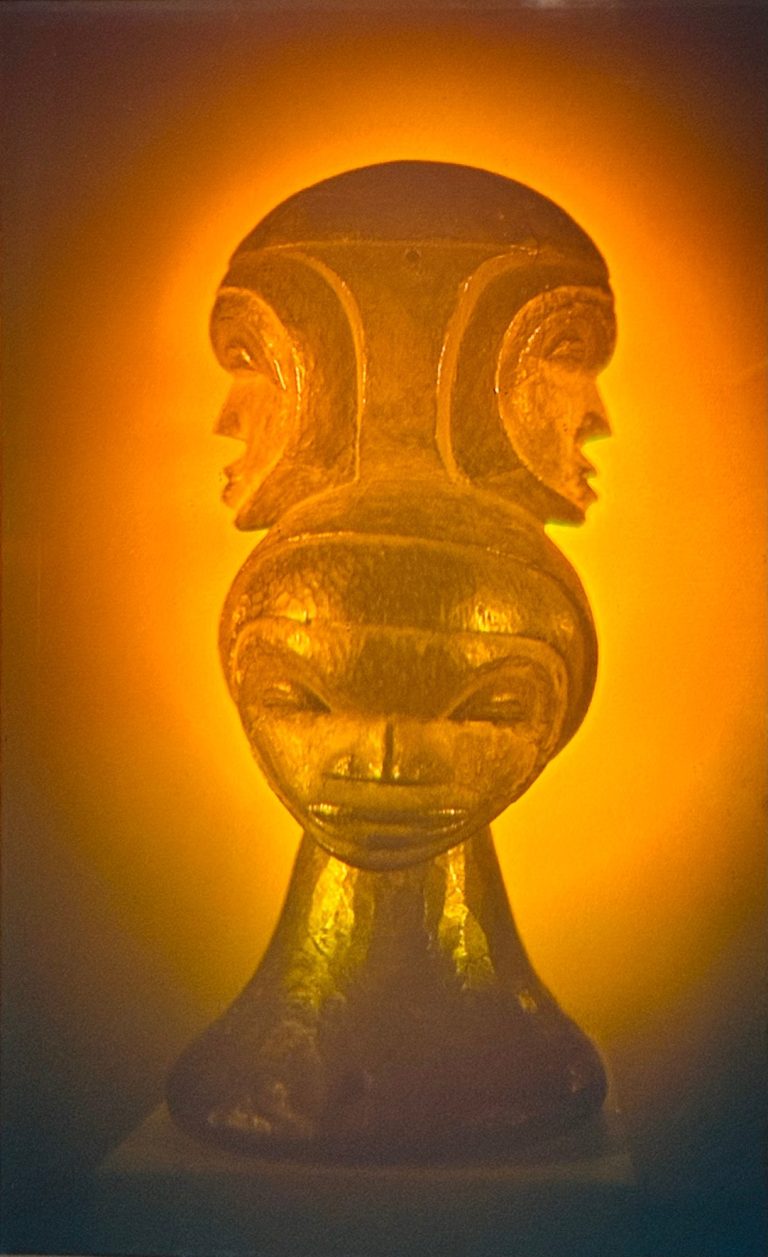
Idoma Figure
23x38cm reflection hologram on glass
Four faced wooden mask,19th century, Eastern Nigeria.
£500.00
Back view.
This four faced figure was carved by a member of the Idoma tribe from eastern Nigeria towards the end of the 19th century. The Idoma live in the region of the Oturkpo to the south of the river Benue. The sculpture was carved from softwood and the outer surfaces were stained with black dye, while the face were daubed with white paint to produce a contrast.
The figure was originally intended to be a mask which would have been part of a ceremonial dance costume. Some types of Idoma masks represented ancestor figures, while others were symbols of power and were worn by judges at criminal trials. Others were kept completely secret and were believed to have the power to kill anyone who discovered their identity. However, the Ungulali mask in this hologram did not have any sinister connotations.
Ungulali masks were openly paraded at the funerals of leading citizens and were worn to provide entertainment on public holidays. Ungulali means flute and the masks were given this name because they were usually preceded by musicians playing flutes. It has been suggested that the reason why they have four faces is so they can look to the left and right and also look backwards into the past and forwards into the future.